Typical Rental Ranges
Daily rentals have the highest per-day cost because setup and teardown are concentrated into a short booking. Weekly and monthly terms spread that labor across more days.
Phoenix Portable Bathrooms helps Phoenix customers plan for mobile shower trailer costs that typically run $200 to $800 per day, $800 to $3,000 per week, or $2,000 to $8,000 per month. The final quote changes with stall count, water heating capacity, water and power access, service frequency, delivery distance, and rental duration, so matching the unit to actual headcount matters.
Daily rentals have the highest per-day cost because setup and teardown are concentrated into a short booking. Weekly and monthly terms spread that labor across more days.
A five-person crew does not need the same capacity as a hundred-person festival. Basic 2-4 stall units cost less than 8-12 stall trailers with greater water-heating and pump capacity.
Confirm headcount, rental dates, delivery access, water and power hookups, and desired service frequency. Those details distinguish a properly sized quote from a generic rate.
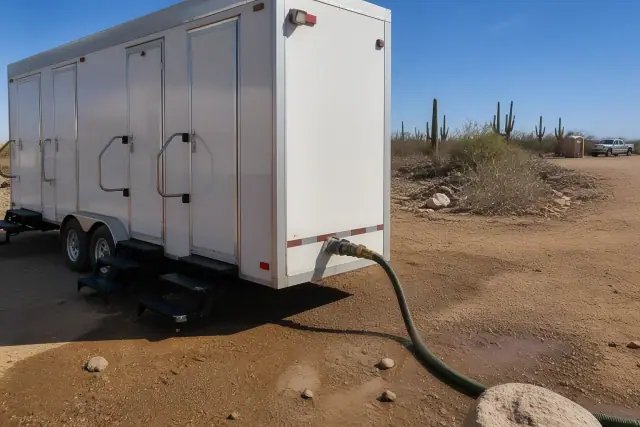
A basic trailer staged on level ground near usable water and electrical connections keeps setup straightforward. Compact capacity works well when the expected headcount is modest.
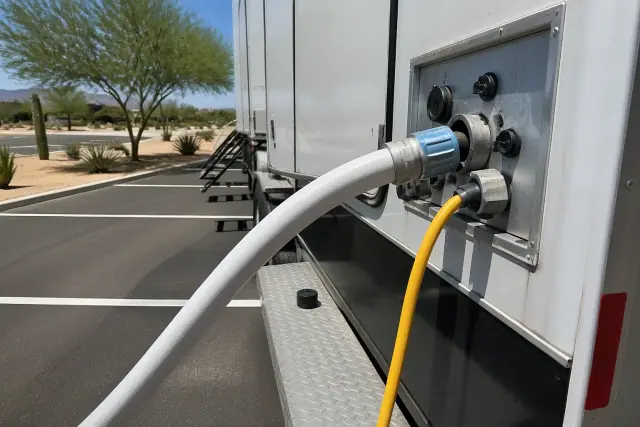
A high-capacity unit needs safe access, utility connections, and enough pump and hot-water recovery for shift-change traffic. Those requirements help explain its higher price tier.
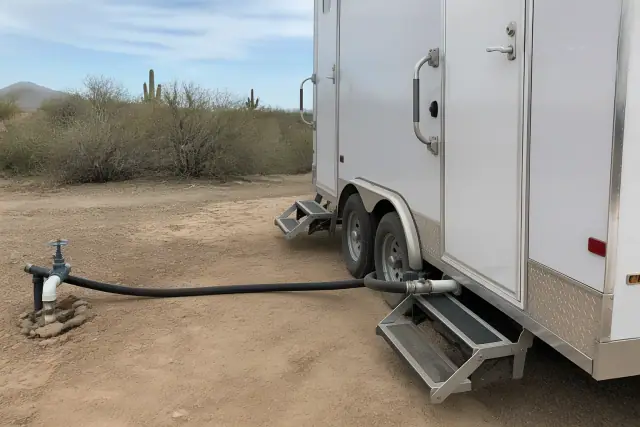
Private shower stalls, restroom fixtures, upgraded finishes, and climate control can be combined in one trailer. These features distinguish a premium event package from a basic crew unit.
When ambient temperatures regularly exceed 100 degrees, climate control can matter for weddings, corporate events, and film production.
A 4-stall unit can serve 15-25 people across a shift, while an 8-12 stall trailer can support 50-100 workers or guests depending on rotation timing.
Units range from single-axle trailers for small jobs to tandem-axle models for higher capacity. Fresh-water tanks typically hold 100-300 gallons, with greywater storage sized to match.
Short-term bookings run from a single day to two weeks for events, shoots, and mobile crews. Long-term contracts typically begin at 30 days for construction, work camps, and extended response operations.
| Rental option | Typical cost | What commonly changes it |
|---|---|---|
| Daily rental | $200-$800 per day | Stall count, hot-water recovery, hookups, and generator needs |
| Weekly rental | $800-$3,000 per week | Equipment size, delivery distance, and servicing frequency |
| Weekend event package | $1,000-$4,500 total | Friday delivery through Monday pickup, stall count, and added hygiene units |
| Monthly rental | $2,000-$8,000 per month | Usage volume, scheduled pump-outs, restocking, and contract length |
| Luxury or high-end combo | $350-$500 per day | Climate control, interior finishes, fixtures, and combined restroom access |
For construction sites along Loop 202 and Loop 101, the practical cost includes reliable hot water, shift-change throughput, hookup access, and service timing. OSHA construction sanitation requirements under 29 CFR 1926.51 call for adequate washing facilities, so project teams should confirm their specific safety requirements rather than assume any trailer configuration is sufficient. Events near Papago Park, South Mountain, and downtown Phoenix may instead prioritize Friday-to-Monday scheduling, privacy, and climate control.
Water-heating capacity matters because Phoenix winter mornings can dip into the 40s even when crews still expect consistent hot water. A site without water or electrical hookups may need self-contained tanks or a generator, while frequent pump-outs and restocking increase servicing needs. Delivery distance also affects pricing: sites in Ahwatukee or Deer Valley generally cost less to service than remote locations past Buckeye. Standalone shower trailers and combined restroom-and-shower units also fall into different equipment classes.
Common follow-ups are what the rental includes, whether accessible or combo layouts are available, and how setup works. Standard trailers include hot and cold water, private stalls, non-slip flooring, and interior lighting, while ADA-compliant units add wider doors, grab bars, and roll-in access. A restroom-and-shower combo adds toilets and sinks to the bathing facilities. Setup depends on site access and hookups because the delivery team must level the unit, connect utilities or a generator, and complete a functionality check.
Share your crew or guest count, rental dates, delivery access, and available water and power. A matched quote can account for stall capacity, tank needs, generator options, servicing, and Phoenix-area delivery.